Motivation
The continuum hypothesis was originally proposed to explain the absence of discrete organizational regimes within tropical cyclone wave fields. Previous analyses demonstrated that observations occupy a continuous distribution in wave-state space rather than clustering into a small number of preferred states. While this established that sea states vary continuously, it did not address whether this continuum possesses an underlying dynamical structure.
To investigate this question, I adopted a trajectory-based perspective in which each storm is treated as a continuous evolution through wave-state space rather than as a collection of independent observations. Instead of examining only only the distribution of observations in space, I constructed rolling-median trajectories describing the evolution of each storm. This approach shifts the emphasis from identifying where observations occur to understanding how wave fields evolve between states.
From a continuum to a dynamical trajectory
The first analysis colored each trajectory by high-frequency directional spread (HFDS). Rather than appearing as an independent variable or exhibiting simple correlations with or , HFDS formed remarkably smooth gradients along each trajectory. As the storms progressed through wave-state space, HFDS evolved continuously and coherently, suggesting that it is closely linked to the developmental state of the wave field rather than to any single bulk parameter.
This observation motivates a refinement of the continuum hypothesis. Rather than representing an unstructured cloud of admissible wave states, the continuum appears to possess a preferred direction of evolution. In other words, storms do not simply occupy continuous states, they progress through an ordered sequence of organizational states.
To compare storms with different lifetimes and translation speeds, each trajectory was parameterized using normalized trajectory position (0-100%), replacing chronological time with a common measure of relative progression through each storm. Although this coordinate is not itself a physical variable, it provides a convenient framework for comparing the evolution of wave-field properties across storms.
When HFDS was plotted against normalized trajectory position, Hurricanes Ian, Idalia, and Milton exhibited remarkably similar functional forms despite substantial differences in intensity, duration, and structure. All three storms showed relatively narrow high-frequency directional spread early in their evolution, a gradual broadening toward a single broad maximum, and a subsequent narrowing during the later stages of the trajectory.
The similarity of these trajectories suggests that the normalized coordinate is capturing a common pattern of wave-field evolution despite the differing characteristics of the individual storms. Whether this reflects an underlying physical trajectory through wave-state space remains an open question, but the normalized representation provides a useful framework for comparing storm evolution and motivates the search for a more physically based progress variable.
A natural next step is to replace this purely normalized coordinate with one based on arc length through wave-state space or another physically motivated measure of wave-state evolution. If storms continue to collapse onto a common trajectory under such a parameterization, it would provide much stronger evidence that tropical cyclone wave fields evolve along a shared developmental pathway rather than simply exhibiting similar normalized behavior.
Physical interpretation
To understand the physical processes governing these trajectories, the same normalized evolution was examined using rolling-median wind speed, MSS, wave age, and HFDS.
The evolution of MSS closely follows the evolution of wind speed. Surface roughness increases steadily as atmospheric forcing strengthens, reaches a broad maximum during the period of strongest winds, and subsequently decreases as forcing weakens. This behavior indicates that the bulk evolution of the sea state is largely controlled by the evolution of the atmospheric forcing.
The behavior of the high-frequency tail, however, is fundamentally different. Although MSS becomes relatively homogeneous near its maximum, HF directional spread continues evolving substantially throughout this period. Sea states exhibiting nearly identical bulk roughness nevertheless span a wide range of directional organization. Thus, the directional organization of the high-frequency tail cannot be uniquely inferred from either wind speed or total roughness.
Coloring the same trajectories by wave age reveals an equally systematic evolution. HF directional spread reaches its broadest values near the minimum wave age, corresponding to the period when the waves are most strongly forced relative to their phase speed. As wave age subsequently increases, directional spread gradually decreases toward intermediate values. Importantly, neither variable uniquely determines the other. Instead, both evolve coherently as manifestations of the same underlying developmental process.
An additional feature appears during the earliest stages of Ian and Milton. Small oscillations in HF directional spread coincide closely with corresponding oscillations in wave age while wind speed remains comparatively unchanged. These early fluctuations therefore appear to reflect rapid adjustments within the developing wave field rather than direct responses to changes in forcing magnitude, reinforcing the interpretation that HF directional organization retains information beyond instantaneous atmospheric forcing.
Taken together, these observations suggest a simple physical picture. Atmospheric forcing drives the bulk evolution of the sea state, while the wave field itself evolves through an internal sequence of organizational states. Bulk properties such as MSS respond primarily to forcing magnitude, whereas the organization of the high-frequency tail continues to evolve according to the developmental history of the wave field.
Figures
Figure 1. MSS evolution organized by storm relative quadrant
Storm-relative evolution of mean square slope
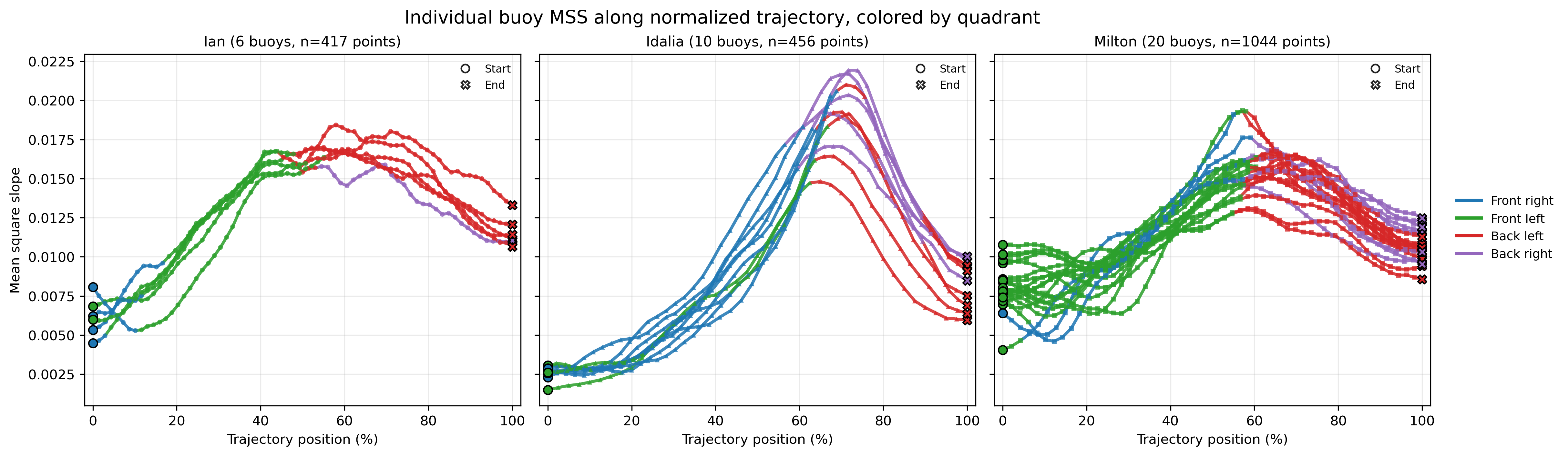
Evolution of mean square slope (MSS) along normalized buoy trajectories, colored by storm-relative quadrant. Individual buoy trajectories from Hurricanes Ian, Idalia, and Milton are shown as a function of normalized trajectory position, allowing storms with different durations and translation speeds to be compared within a common storm-relative framework. MSS evolves consistently across storms, increasing steadily during approach toward the storm core, reaching a broad maximum near 60–70% of the trajectory, and subsequently decreasing as the storm departs. Much of the remaining variability is organized by storm-relative quadrant, demonstrating that bulk surface roughness is strongly constrained by storm-relative forcing geometry.
Figure 2. MSS evolution colored by wind speed
MSS evolution follows the forcing
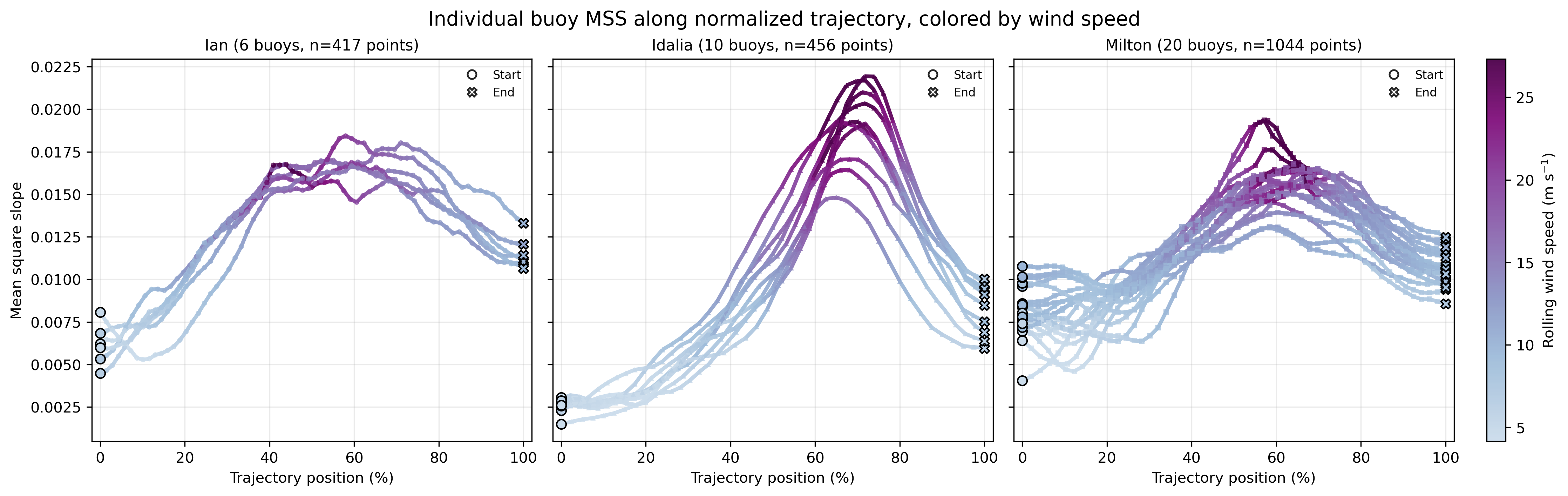
The same normalized MSS trajectories colored by rolling wind speed. Wind speed increases nearly monotonically toward the period of maximum MSS before decreasing during the exit portion of each trajectory, confirming that the primary evolution of surface roughness closely follows the evolution of atmospheric forcing. Although trajectories with similar wind speeds exhibit modest differences in MSS, the overall relationship remains highly constrained, indicating that forcing largely determines the bulk development of the sea state.
Figure 3. High Frequency directional spread colored by MSS
High-frequency directional organization continues evolving after bulk roughness saturates
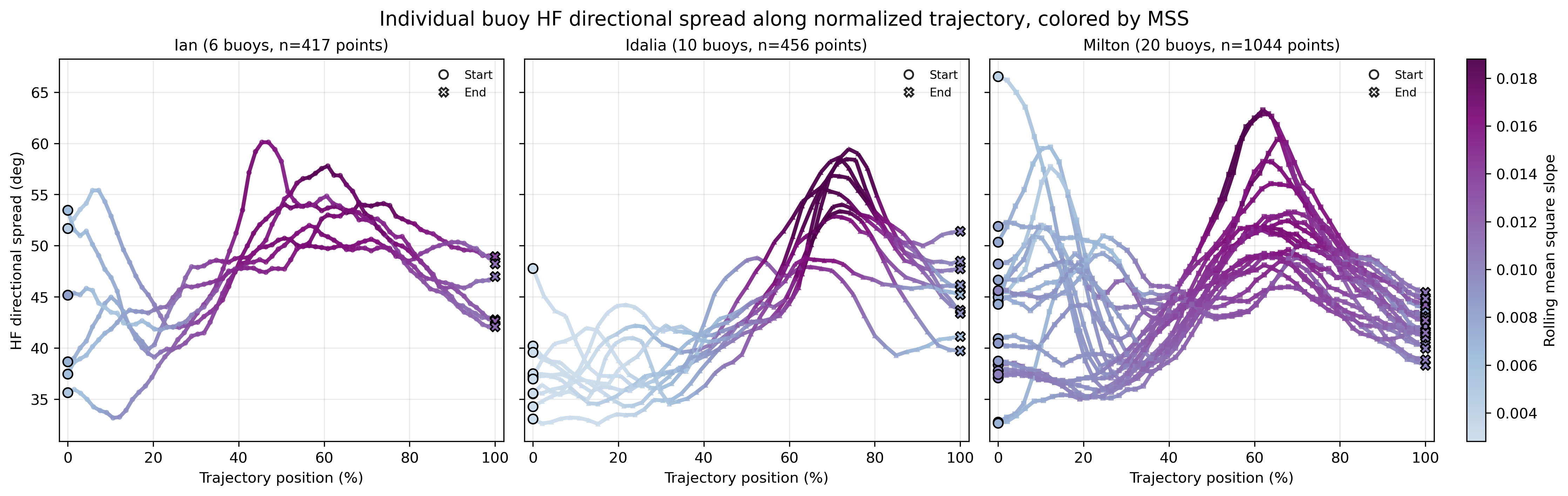
Evolution of high-frequency directional spread along normalized buoy trajectories colored by rolling MSS. Unlike the bulk quantities shown in Figures 1 and 2, HF directional spread continues evolving even while MSS remains relatively homogeneous near its maximum values. Sea states with nearly identical bulk roughness exhibit markedly different directional organization of the high-frequency tail. This demonstrates that similar levels of surface roughness do not uniquely correspond to a single organizational state. Instead, the directional organization of the shortest waves represents an additional degree of freedom that evolves alongside, but independently from, the bulk sea state.
Figure 4. High Frequency directional spread colored by wave age
High-frequency organization reflects wave maturity while retaining independent variability
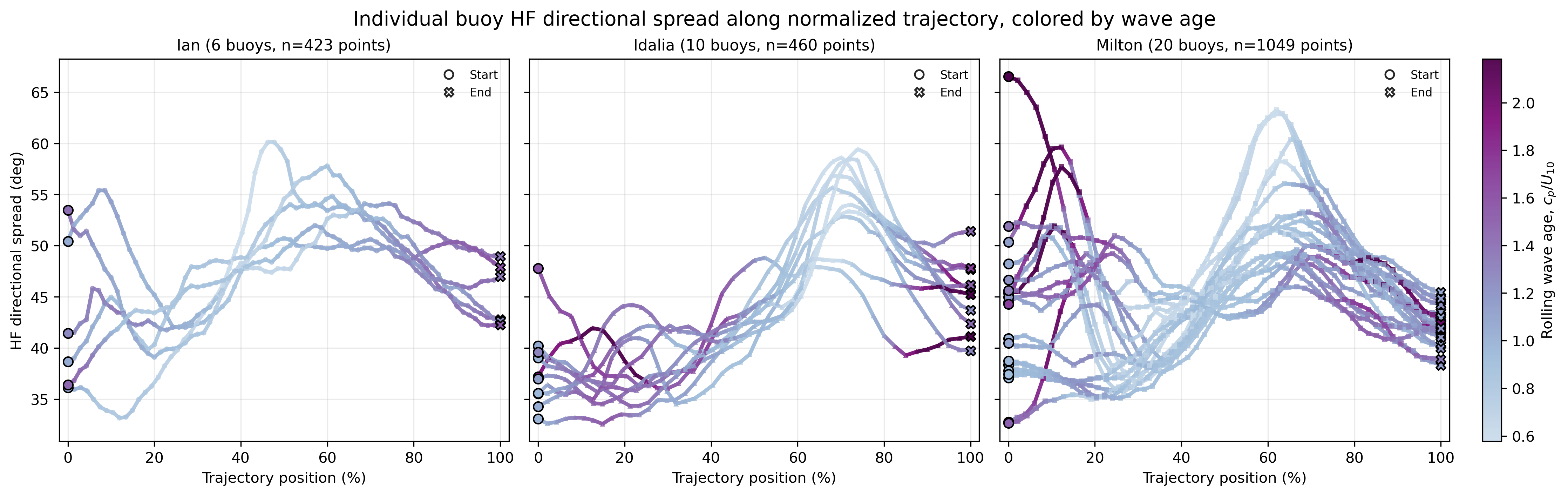
The same normalized HF directional spread trajectories colored by rolling wave age . Directional spread evolves systematically as the wave field matures, with its broadest values occurring near minimum wave age before gradually decreasing as the waves mature. Nevertheless, substantial variability persists among trajectories with similar wave ages, indicating that wave maturity alone does not uniquely determine the organization of the high-frequency tail. Together with Figure 3, these results suggest that high-frequency directional organization evolves through the combined influence of forcing history and spectral development while retaining variability beyond that captured by conventional bulk sea-state metrics.
Implications for air-sea interactions
The most significant outcome of this analysis is the apparent decoupling between bulk surface roughness and the directional organization of the high-frequency tail. Bulk quantities such as MSS become relatively constrained once the wave field reaches mature conditions, whereas HF directional spread continues to evolve through a broad range of organizational states.
This observation suggests that the sea state possesses an additional degree of freedom beyond those represented by conventional bulk parameters. Rather than being uniquely determined by wind speed or total roughness, the directional organization of the shortest waves appears to evolve according to the developmental history of the wave field.
One possible implication is that air–sea momentum exchange depends not only on the magnitude of short-wave roughness but also on its directional organization. If wave-supported stress is carried primarily by the wind-aligned component of the high-frequency tail, then redistributing short-wave energy across a broader range of propagation directions could reduce the efficiency of momentum transfer while leaving total MSS largely unchanged. Under this interpretation, drag would depend not only on wind speed and roughness magnitude but also on the organization of the high-frequency wave field.
At present this remains a physical hypothesis rather than an observational conclusion. Direct covariance measurements of momentum flux are largely unavailable under the highest tropical cyclone wind speeds, making it impossible to directly evaluate the relationship between directional organization and drag. Likewise, quantities such as friction velocity or drag coefficient derived from wave spectra inevitably rely on parameterizations that embed assumptions regarding the air–sea interaction itself.
Consequently, this work does not attempt to infer drag directly from the directional spectra. Instead, it establishes an observational foundation for a new hypothesis: that high-frequency directional organization represents an independent state variable capable of modulating the efficiency of wave-supported momentum transfer under otherwise similar forcing conditions. Testing this hypothesis will ultimately require either direct flux measurements in extreme conditions or coupled atmosphere–wave simulations capable of resolving both the evolving directional wave spectrum and the atmospheric boundary layer.
Future Work
A natural next step is to investigate whether storm trajectories collapse onto a common trajectory when parameterized using arc length through wave-state space rather than independent normalization. If multiple storms project onto a shared developmental pathway, it would provide strong evidence that tropical cyclone wave fields evolve through a common sequence of organizational states rather than following storm-specific trajectories.
Equally important will be developing physically based diagnostics that quantify the wind-aligned component of high-frequency roughness. Such quantities may provide a more direct connection between the evolving organization of the wave spectrum and air–sea momentum exchange than conventional bulk metrics alone.