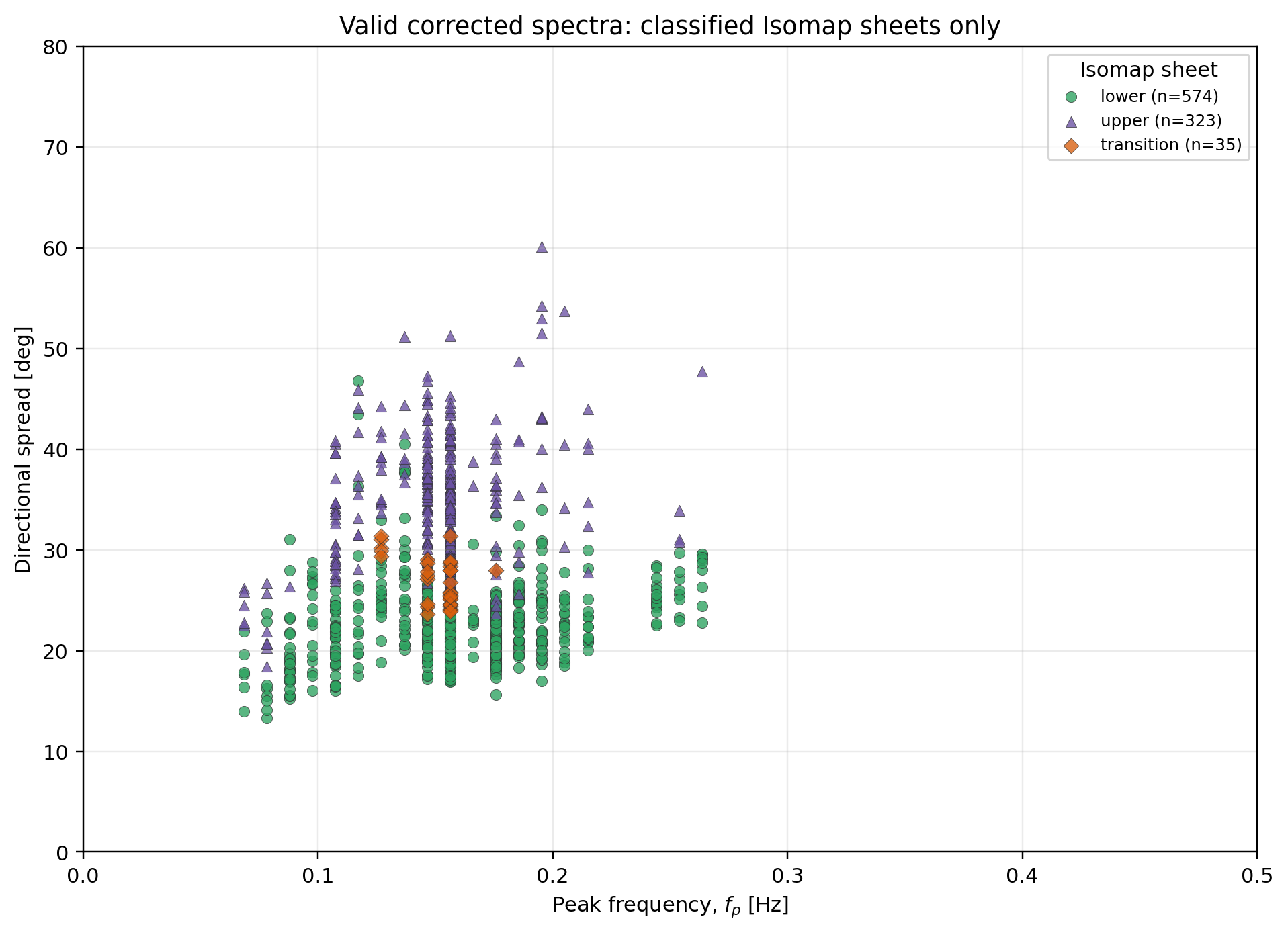
This figure illustrates the relationship between peak frequency () and directional spread for the wave spectra classified into the lower, upper, and transition Isomap sheets. While the manifold learning separates the observations into distinct groups, the dominant feature of the distribution is not the existence of separate branches, but rather the evolution of the range of directional spread with peak frequency. At low and high peak frequencies, directional spread occupies a relatively narrow range, whereas at intermediate peak frequencies the wave field exhibits substantially greater variability, with directional spreads ranging from approximately 18° to over 60°. The transition class lies almost entirely within this region of increased variability, reinforcing the idea that this is a continuum rather than a sharp boundary between states.
This behavior is consistent with the evolving conceptual model of tropical cyclone wave development. Rather than progressing through two fundamentally distinct sea-state regimes, the observations suggest that the wave field evolves from a highly constrained state at low forcing, into an intermediate regime where multiple directional organizations are dynamically possible, before returning toward a more constrained state under stronger forcing. In this interpretation, the apparent Isomap “sheets” are not independent evolutionary pathways, but instead represent different organizational realizations that are accessible within this intermediate portion of the forcing space.
Importantly, the convergence of both the lower and upper sheets toward similar directional spreads at higher peak frequencies provides evidence that these organizational states merge as forcing becomes sufficiently strong. This interpretation is supported by the corresponding alignment analyses, which likewise show decreasing variability and increasingly consistent directional organization at higher wind speeds. Together, these results suggest that increasing wind forcing progressively limits the degrees of freedom available to the wave field, driving convergence toward a common organizational state regardless of the pathway taken during earlier stages of development.
This reinterpretation naturally shifts the focus away from the Isomap sheets themselves and toward the physical mechanisms controlling variability within the intermediate forcing regime. The manifold appears to be capturing an expansion and subsequent contraction of the accessible state space, where differences in high-frequency directional organization become the primary source of variability among otherwise similar bulk sea states. This emerging framework provides a physical explanation for why similar peak frequencies and mean square slopes can exhibit different levels of wave-supported stress and air-sea momentum exchange: during the intermediate regime, the bulk wave properties no longer uniquely determine the structure of the high-frequency tail. As forcing continues to increase, these differences diminish, producing the observed merging of the Isomap sheets and supporting the hypothesis that strong wind forcing ultimately constrains the wave field toward a common equilibrium organization.