Understanding the evolution of tropical cyclone wave fields requires separating variability that is an expected response to the local wind environment from variability arising from the evolving state of the wave field itself. The framework adopted here is illustrated schematically in Figure 1. Rather than attempting to model all observed variability simultaneously, the analysis proceeds in two stages. First, a smooth wind-only generalized additive model (GAM) is used to characterize the first-order equilibrium relationship between the instantaneous local wind environment and several bulk and spectral wave-state descriptors. The resulting model represents the portion of the observed wave state that is expected under an instantaneous equilibrium assumption, where local wind speed and associated environmental variables uniquely determine the wave field.
Figure 1
The remaining unexplained variability is then treated as a physically meaningful residual rather than statistical noise. This residual provides a quantitative measure of the degree to which the observed wave field departs from the equilibrium predicted by the local wind environment. The central hypothesis of this work is that these departures contain information about additional physical processes that are not represented by instantaneous forcing alone. These processes can be broadly divided into two classes. The first consists of external forcing descriptors, including storm geometry, storm translation, and forcing history, which characterize how the wind field evolves in space and time. The second consists of wave-state descriptors that characterize the internal organization of the wave field itself, including measures of disequilibrium and spectral organization such as wave age, wind-wave misalignment, directional spreading, alignment, and directional offsets. Together these quantities provide a pathway toward progressively more physics-informed descriptions of tropical cyclone wave evolution while retaining the wind-only model as an interpretable baseline.
The purpose of the present section is therefore not to construct the final predictive model, but rather to establish this baseline, quantify the magnitude of the unexplained variability, and determine whether the residual contains systematic physical structure capable of motivating additional model development.
Generalized additive models were independently fit for each response variable using the response transformations described previously. Predictor variables consisted only of contemporaneous descriptors of the local wind environment, allowing each response to be interpreted as the expected equilibrium wave state under instantaneous forcing. Model performance was evaluated using leave-one-storm-out cross validation so that predictive skill reflected generalization across independent storms rather than interpolation within individual events.
The resulting baseline models demonstrate that a large fraction of the variability in several primary wave descriptors can indeed be explained by the local wind environment (Figure 2). Significant wave height, mean square slope, and the relative high-frequency energy ratio all exhibit explained deviances approaching 0.75, while peak frequency retains moderate predictive skill despite its greater sensitivity to spectral evolution. These results indicate that much of the energetic evolution of the wave field is well approximated as a smooth equilibrium response to the local wind forcing.
Figure 2
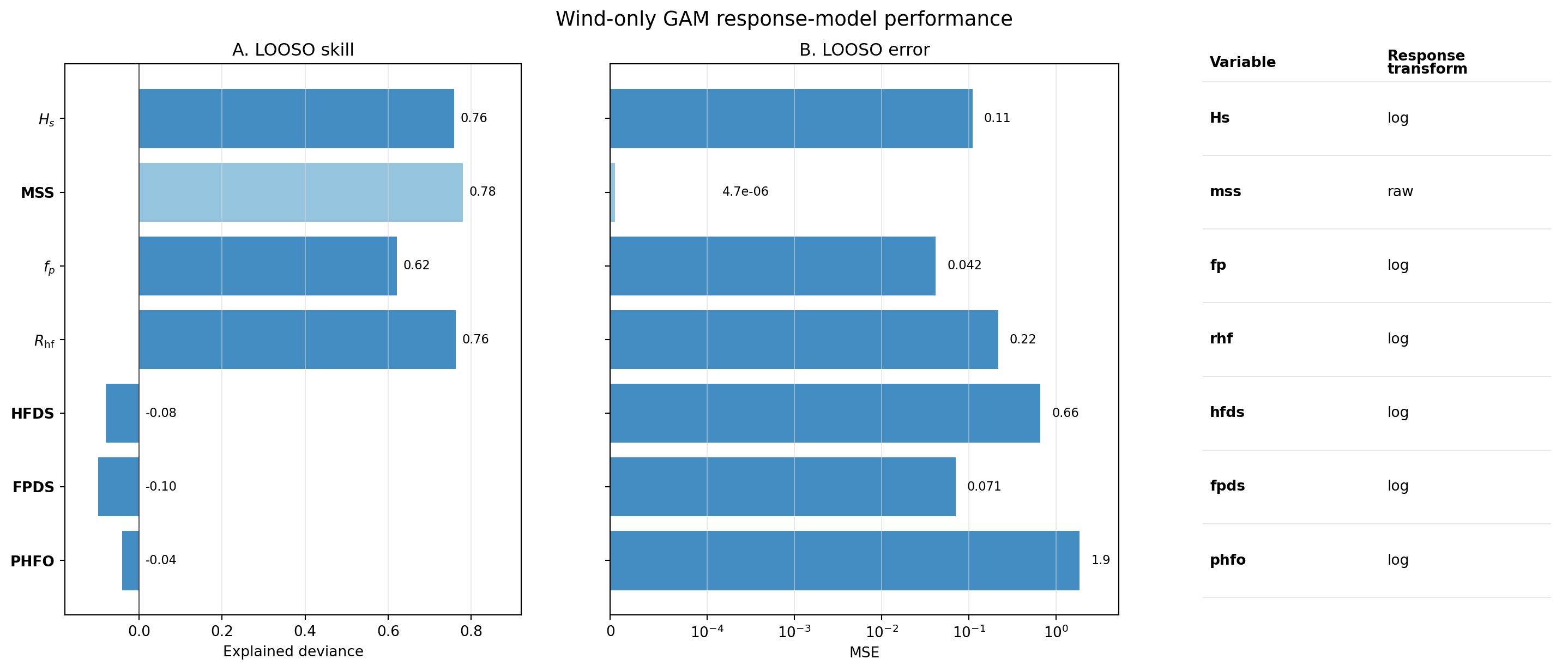
In contrast, the directional organization variables exhibit essentially no predictive skill. High-frequency directional spread, peak-frequency directional spread, and the peak-to-high-frequency directional offset all produce explained deviances near zero despite being modeled using the same predictor set. Rather than representing poor model performance, this result suggests that these variables are not controlled directly by the instantaneous wind field. Instead, they appear to encode information associated with the evolving state of the wave spectrum itself. This distinction immediately motivates the residual analysis that follows. If these quantities contain information absent from the wind-only equilibrium description, they may provide the additional state variables required to explain the remaining variability in the energetic descriptors.
The storm-relative residual maps provide the first test of this hypothesis (Figure 3). After subtracting the wind-only prediction, the residuals do not collapse into spatially random scatter. Instead, coherent structures persist throughout normalized storm space. Residuals in significant wave height and mean square slope exhibit remarkably similar spatial organization, with coherent positive and negative regions extending across multiple quadrants. Peak frequency and the high-frequency energy ratio exhibit complementary structures that frequently oppose those of the energetic variables. These patterns demonstrate that the unexplained variability is organized in space and therefore likely reflects unresolved physical processes rather than random prediction error.
Figure 3
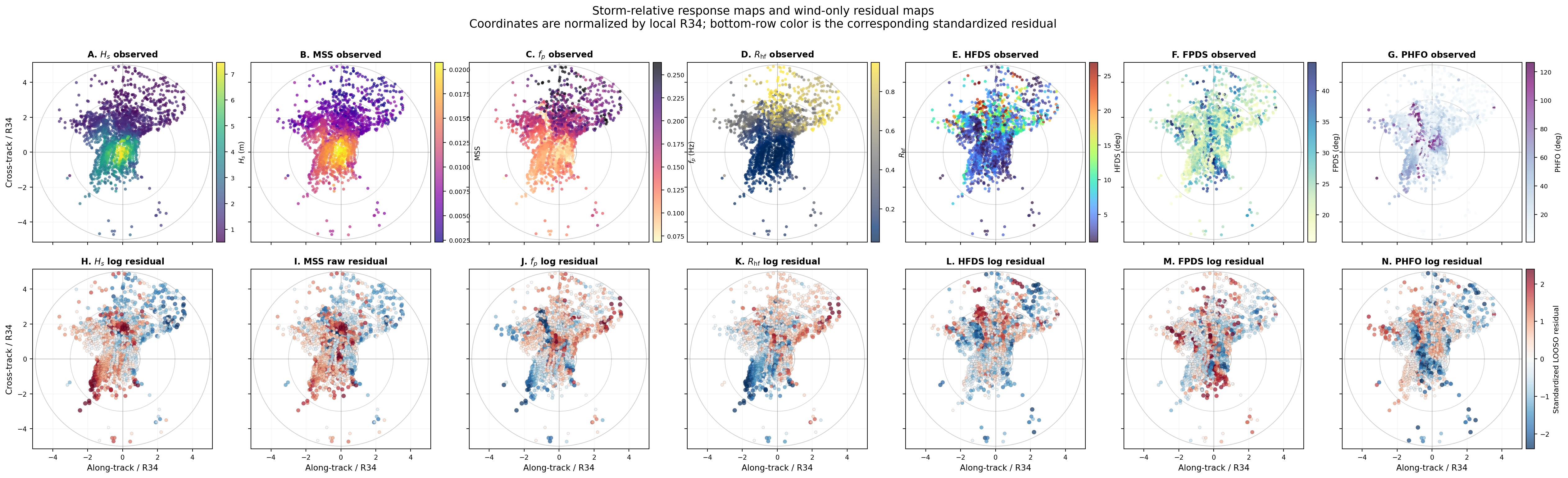
Equally important is the behavior of the directional descriptors. Although the wind-only model provides essentially no predictive skill for HFDS, FPDS, or PHFO, their residual fields remain highly organized. Their spatial coherence indicates that these variables are themselves systematic components of the wave-state evolution rather than noisy quantities. This observation supports the conceptual framework proposed in Figure 1, where directional organization is treated not as an additional response variable to be predicted directly from wind, but as an internal descriptor of the wave state capable of explaining structured departures from equilibrium.
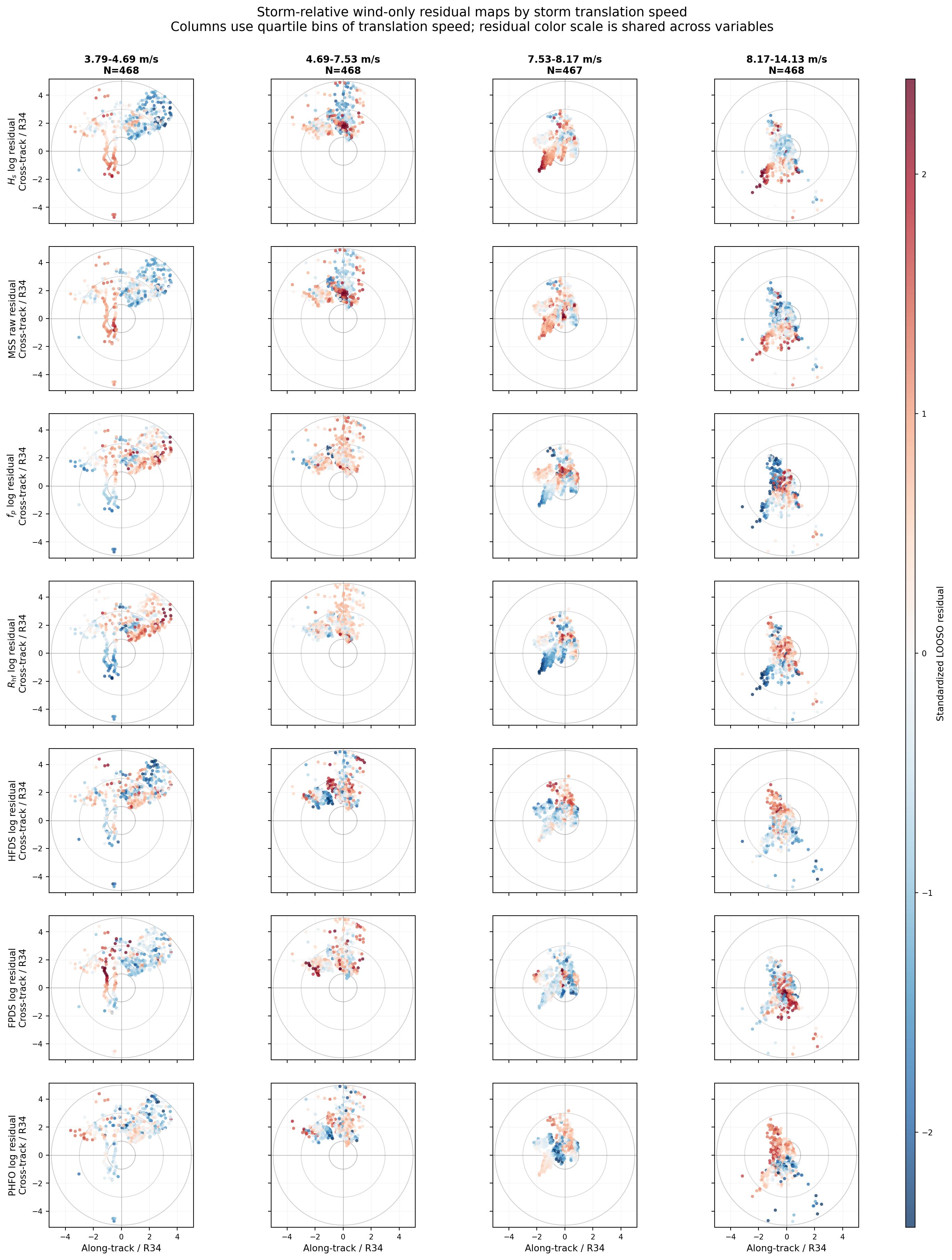
Stratifying the residual fields by storm translation speed further demonstrates that the residual structure evolves systematically with storm characteristics (Figure 4). The covariance between Hs and MSS remains largely invariant across translation-speed bins, while peak frequency and relative high-frequency energy continue to evolve together with opposite sign relative to the energetic variables. The overall organization of the residual fields nevertheless changes substantially with storm speed, indicating that storm translation influences the spatial evolution of the wave field rather than simply scaling the equilibrium response. Once again, the directional descriptors evolve differently from the energetic variables, suggesting that they respond to storm evolution through mechanisms that extend beyond instantaneous wind forcing alone.
Figure 4
The covariance structure of the residual variables provides perhaps the strongest evidence that the residual represents physically meaningful wave-state variability (Figures 5 and 6). Across both storm and storm-quadrant partitions, significant wave height and mean square slope remain consistently and strongly correlated, while peak frequency and the relative high-frequency energy ratio exhibit similarly robust covariance. Although the magnitude of these correlations varies between storms and storm-relative regions, the overall sign structure remains remarkably stable. Such consistency would be unexpected if the residual fields primarily reflected random model error.
Figure 5
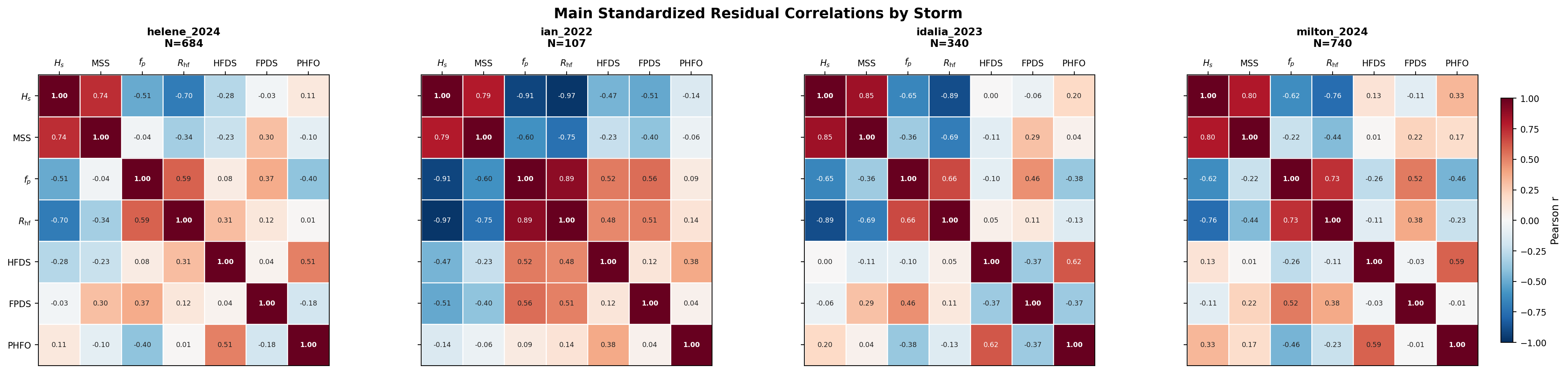
Figure 6
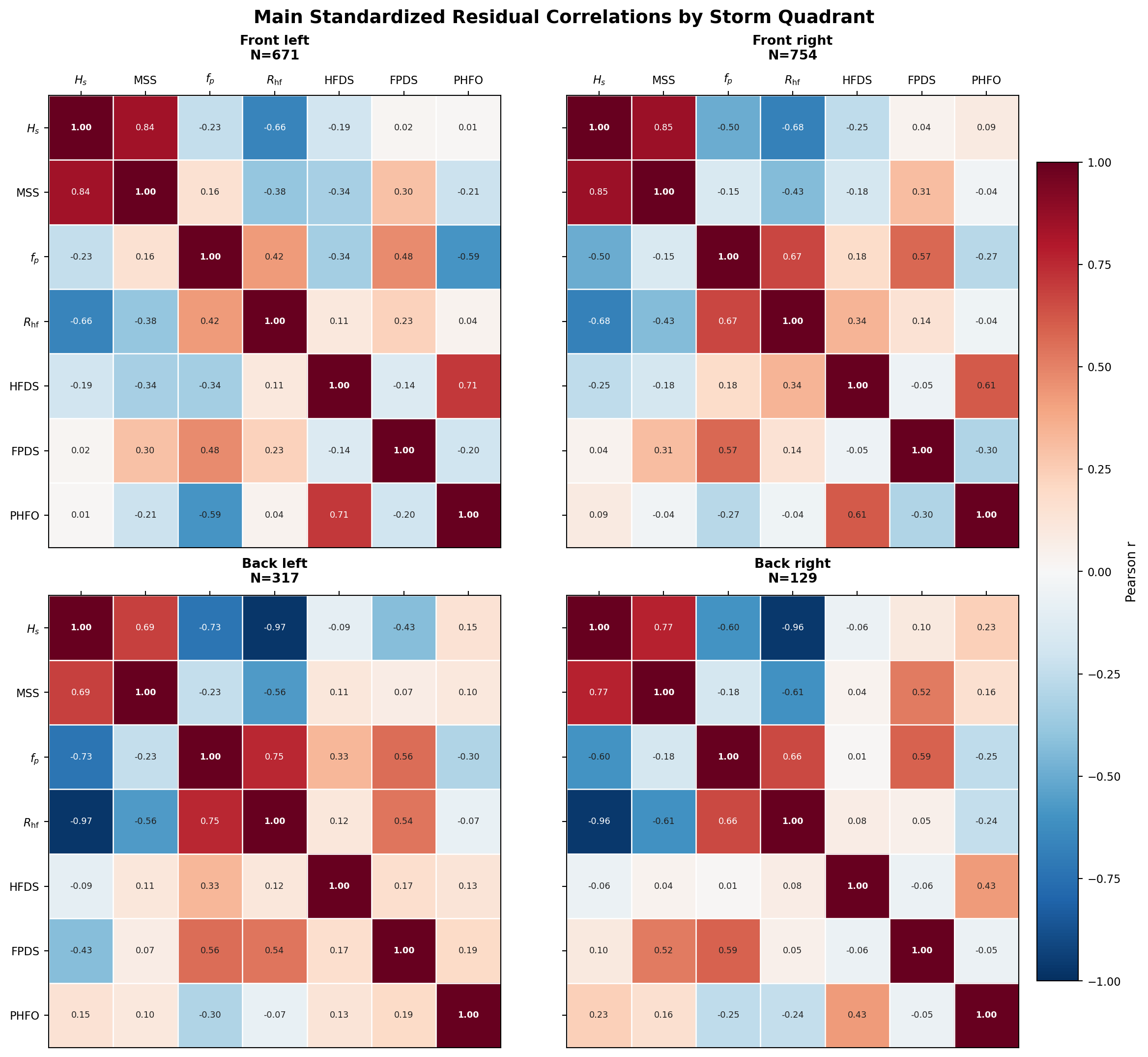
The directional descriptors exhibit markedly different behavior. Correlations involving HFDS, FPDS, and PHFO vary substantially among storms and quadrants, both in sign and magnitude. Rather than weakening the interpretation, this variability suggests that directional organization occupies a higher-dimensional state space than the bulk energetic descriptors. FPDS consistently exhibits positive relationships with peak frequency while remaining comparatively independent of Hs, whereas PHFO is most closely associated with HFDS. Together these observations imply that different measures of directional organization capture distinct aspects of spectral structure rather than redundant representations of the same process. Their weak relationship to the energetic variables further supports the interpretation that they represent additional state variables rather than alternative measures of wave energy.
Taken together, these analyses establish a coherent progression from an equilibrium description toward a more complete physics-informed representation of tropical cyclone wave evolution. The wind-only GAM successfully captures the first-order response of the energetic wave field to the local wind environment, confirming that much of the observed variability is consistent with an instantaneous equilibrium assumption. However, the remaining variability is neither random nor negligible. Instead, it exhibits coherent storm-relative organization, systematic dependence on storm characteristics, and persistent covariance across independent storms. Perhaps most importantly, variables describing directional organization contain little information about the instantaneous wind field while exhibiting strong internal structure of their own. This combination strongly suggests that these descriptors encode information about the evolving state of the wave spectrum itself.
The wind-only model therefore serves not as the final objective of the analysis but as an intentionally simplified equilibrium baseline from which progressively more complete wave-state models can be developed. The residual variability identified here provides both the motivation and the framework for introducing additional physics through descriptors of forcing history, storm evolution, and spectral organization. In this way, the residual becomes not simply an error term, but the principal diagnostic through which missing physical processes can be identified and incorporated into increasingly physics-informed descriptions of tropical cyclone wave-state evolution.